[Robotics 5. 물류 혁명의 주역 : AMR과 AGV가 바꾸는 창고의 풍경 (Logistics Revolution Leaders: How AMR and AGV are Changing the Warehouse Landscape)
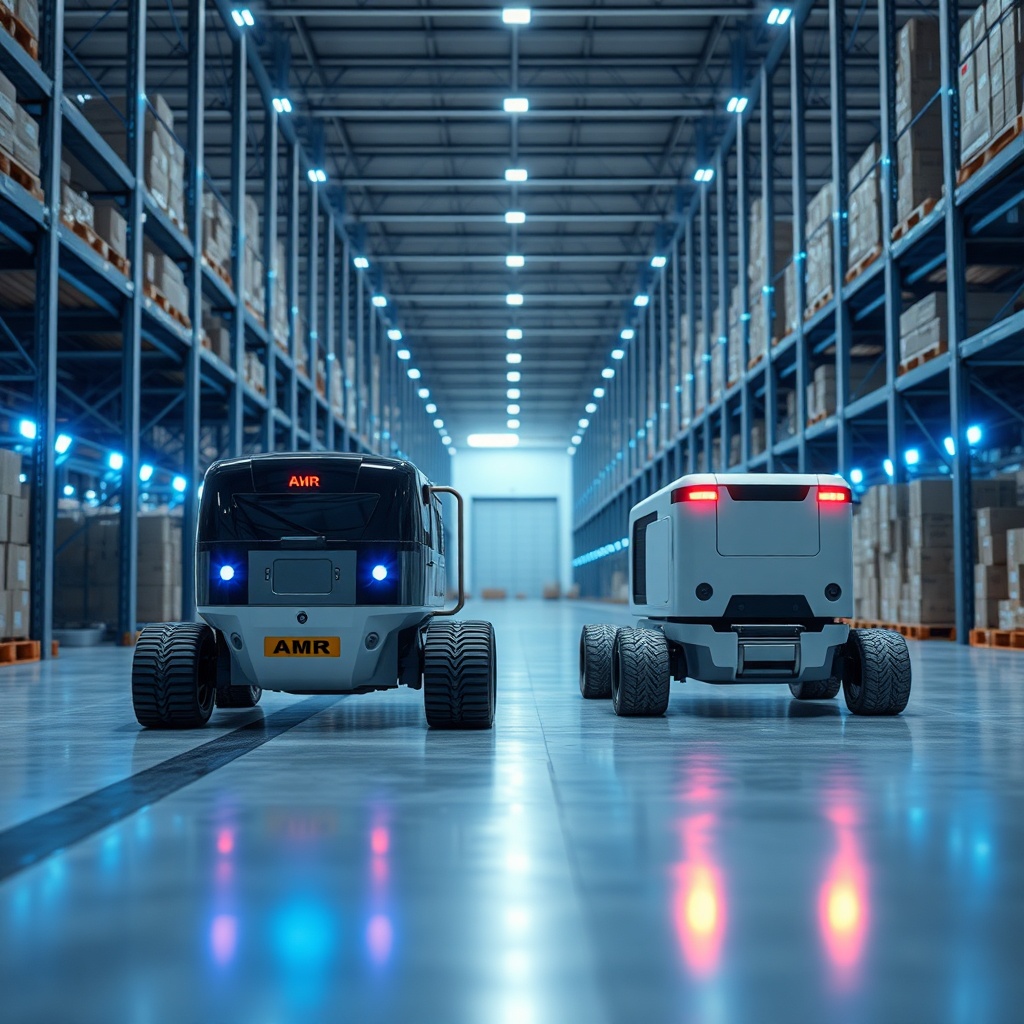
안녕하세요, 23년 차 IT 기획 팀장입니다. 새벽 배송과 당일 배송이 기본이 된 시대, 소비자의 기대치는 하늘을 찌르는데, 물류 창고는 인력 부족과 비효율이라는 이중고에 시달립니다. 저는 지난 몇 년간 수많은 디지털 전환(DX) 프로젝트를 진행하며 물류 자동화의 중요성을 뼈저리게 체감했습니다. 🎤
오늘 리포트의 핵심 관전 포인트는 '로봇이 정해진 길을 가는 시대(AGV)'에서 '로봇이 스스로 길을 찾는 시대(AMR)'로의 전환입니다. 이 전환은 단순히 기계의 업그레이드를 넘어, 물류 현장의 유연성과 확장성, 그리고 궁극적으로 이커머스의 적재 효율을 극대화하는 핵심 열쇠가 됩니다. 로봇이 정말 우리 업무의 동료가 될 수 있을지, 현장 관점에서 깊이 파헤쳐 보겠습니다. 🚀
1. 개념 소개: AGV와 AMR, 무엇이 다른가? 💡
자율주행 물류 로봇을 논할 때 가장 많이 언급되는 두 기술은 AGV(Automated Guided Vehicle)와 AMR(Autonomous Mobile Robot)입니다. 이 둘의 차이점을 명확히 이해해야만 우리 회사에 적합한 솔루션을 선택할 수 있습니다. 쉽게 말해, AGV는 '정해진 경로만 따라가는 기차'라면, AMR은 '스스로 경로를 바꾸는 자율주행차'와 같습니다.
AGV (Automated Guided Vehicle): 신뢰성의 대명사
AGV는 바닥에 설치된 자기 테이프, 와이어, 또는 광학 가이드라인을 따라 이동합니다. 경로가 고정되어 있어 예측 가능성이 높고, 대규모 반복 작업에는 매우 안정적입니다. 하지만 경로를 변경하려면 물리적인 인프라를 수정해야 하므로 유연성이 현저히 떨어집니다.
AMR (Autonomous Mobile Robot): 유연성과 지능의 결합
AMR은 LiDAR, 비전 센서, 그리고 AI를 활용하여 주변 환경을 실시간으로 매핑하고 이해합니다. 경로상에 장애물이 나타나면 스스로 우회 경로를 계산하여 작업을 지속합니다. 특히 다품종 소량 생산이 일반적인 이커머스 창고나 복잡한 제조 라인에서 그 가치가 폭발적입니다.
| 구분 | AGV (Guided) | AMR (Autonomous) |
|---|---|---|
| 경로 지정 | 물리적 가이드(테이프, 와이어) 필요 | AI 기반 SLAM(동시적 위치 추정 및 지도 작성) |
| 유연성 | 매우 낮음 (경로 변경 시 공사 필요) | 매우 높음 (실시간 우회 및 경로 최적화) |
| 설치 비용 | 초기 인프라 구축 비용 높음 | 상대적으로 낮음 (소프트웨어 중심) |
2. 물류 현장의 풍경 변화: AMR이 창조하는 '스마트 피킹' 🏭
AMR 도입은 단순히 물건을 옮기는 속도를 높이는 것을 넘어, 물류 흐름 자체를 혁신합니다. 가장 대표적인 변화는 바로 ‘Goods-to-Person’ 방식의 확산입니다. 기존에는 작업자가 넓은 창고를 돌아다니며 물건을 찾아(Person-to-Goods) 담았지만, 이제는 로봇이 선반이나 랙을 통째로 작업자에게 가져다줍니다.
글로벌 사례: 아마존의 Kiva 시스템의 진화
이미 수년 전부터 아마존은 Kiva(현재 Amazon Robotics Drive) 로봇을 통해 이 방식을 도입하여 창고의 적재 밀도와 피킹 속도를 혁신적으로 높였습니다. Kiva 로봇은 주문이 들어오는 즉시 최적의 경로를 따라 이동하며 해당 물품이 담긴 선반을 작업 스테이션으로 운반합니다. 제가 현장에서 확인한 바로는, 이 시스템 덕분에 작업자의 이동 거리가 80% 이상 줄어들었습니다.
국내 사례: 소규모 이커머스의 적응
국내 대형 물류센터뿐만 아니라, 중소규모의 3PL(제3자 물류) 업체들도 AMR을 도입하기 시작했습니다. 특히 냉장/냉동 물류와 같이 인간의 작업 환경이 비효율적이거나 힘든 곳에 AMR을 투입하여 휴먼 에러를 줄이고 작업 효율을 2배 이상 높이는 성공 사례가 속속 나오고 있습니다. AMR은 초기 AGV 인프라만큼 대규모 투자가 필요 없기 때문에, 스타트업이나 중소기업도 비교적 쉽게 접근할 수 있게 된 것입니다.
3. 최신 트렌드: AI와 FMS가 이끄는 '군집 지능' 🌐
최신 로보틱스 트렌드는 단순히 개별 로봇의 성능을 높이는 것을 넘어, 수백 대의 로봇을 하나의 지능으로 관리하는 방향으로 진화하고 있습니다. 바로 FMS(Fleet Management System)와 AI 기반의 경로 최적화 기술입니다.
트렌드 1: 군집 주행과 충돌 회피의 고도화
AI는 실시간 주문 데이터, 재고 위치, 그리고 다른 로봇들의 이동 경로를 종합적으로 분석하여 최단 시간이 아닌 '가장 효율적인' 경로를 즉시 할당합니다. 마치 잘 훈련된 군대처럼, 수십 대의 AMR이 복잡하게 얽힌 창고 내부를 충돌 없이 유기적으로 움직입니다. AMR 기술의 발전은 이제 하드웨어보다 소프트웨어(AI 알고리즘) 역량에 달려있습니다.
트렌드 2: RaaS와 민주화
로봇 도입 초기에는 막대한 자본 투입(CAPEX)이 필요했지만, 최근에는 RaaS(Robotics as a Service) 모델이 확산되면서 월별 구독 형태로 로봇을 운영할 수 있게 되었습니다. 이는 특히 물류량이 급증하는 명절이나 특정 시즌에만 로봇을 유연하게 추가할 수 있게 하여, 중소기업에게 로보틱스 도입의 문턱을 획기적으로 낮춰주었습니다.
AMR의 지능적인 운영은 안정적인 네트워크 환경(Wi-Fi 5G, 또는 6G)에 전적으로 의존합니다. FMS는 실시간 데이터 교환을 요구하기 때문에, 로봇 도입 전에 무선 통신 환경의 데드존과 속도를 철저히 점검해야 합니다. 자율주행차와 마찬가지로, 끊기는 네트워크는 곧 물류 마비로 이어질 수 있습니다.
4. 비즈니스적 의미와 시사점: 확장성을 확보하라 📈
AMR 도입은 단순히 인건비를 절약하는 차원을 넘어, 비즈니스의 확장성(Scalability)을 보장합니다. 전통적인 물류 시스템은 물류량이 늘어나면 창고를 확장하거나 인력을 급하게 충원해야 했지만, AMR은 필요한 만큼만 유연하게 투입할 수 있습니다.
기획자의 시각에서 주목해야 할 점은, 로봇 도입이 인간을 대체하는 것이 아니라, 인간을 더 고부가가치적인 업무로 전환시키는 촉매제가 된다는 것입니다. 로봇은 단순 반복적인 이동과 적재를 수행하고, 숙련된 인력은 예외 상황 처리, 로봇 관리, 그리고 시스템 최적화와 같은 전문적인 업무를 담당하게 됩니다. 이것이 바로 로보틱스가 가져오는 진정한 '노동력 재정의'입니다.
5. 업무 활용 팁: 현장에 맞는 모바일 로봇 선택 전략 🎯
물류 환경이 매우 안정적이고(장애물 없음), 작업 경로가 수년간 변하지 않을 것이며, 오직 대량의 단일 품목 운반이 주 목적이라면 AGV가 비용 효율적일 수 있습니다. 초기 구축 비용이 높아도 장기적인 안정성을 최우선으로 해야 할 때 적합합니다.
이커머스처럼 주문이 시시각각 변하고, 작업자나 지게차 등 동적 장애물이 많으며, 창고 레이아웃이 자주 바뀌어야 하는 환경이라면 AMR이 유일한 대안입니다. 파일럿 프로젝트를 진행할 때는 전체 창고가 아닌 특정 구역(예: 재고 랙킹 구역)에 집중하여 AMR의 성능과 FMS의 통합 운영 능력을 먼저 검증하는 것이 필수입니다.
이제 로보틱스는 '선택'이 아닌 '생존'의 문제가 되었습니다. 특히 물류 영역에서 AMR의 유연성은 곧 기업의 시장 대응력과 직결됩니다. 오늘 배운 관점을 통해 여러분의 현장을 다시 한번 바라보고, 로봇을 단순한 기계가 아닌 디지털 혁신의 핵심 파트너로 인식하는 계기가 되기를 바랍니다. 다음 리포트에서는 협동 로봇(Cobot)의 실제 제조업 현장 투입 전략을 다루겠습니다. 기대해 주세요! 😊
Logistics Revolution Leaders: How AMR and AGV are Changing the Warehouse Landscape
Hello, I'm an IT Planning Team Leader with 23 years of experience. In an era where same-day and next-day delivery are standard, consumer expectations are skyrocketing, but warehouses face the double challenge of labor shortages and inefficiency. Over the past few years, I've personally felt the crucial importance of logistics automation during numerous Digital Transformation (DX) projects. 🎤
The core observation point of today's report is the transition from the 'era where robots follow fixed paths (AGV)' to the 'era where robots find their own paths (AMR)'. This shift is more than just a machine upgrade; it is the key to maximizing logistics flexibility, scalability, and ultimately, optimizing storage efficiency for e-commerce. Let's delve deep into whether robots can truly become our operational partners from a field perspective. 🚀
1. Concept Introduction: AGV vs. AMR, What's the Difference? 💡
When discussing autonomous logistics robots, the two most frequently mentioned technologies are AGV (Automated Guided Vehicle) and AMR (Autonomous Mobile Robot). Understanding their differences is essential for selecting the right solution for your company. Simply put, if an AGV is a 'train following a fixed track,' an AMR is a 'self-driving car changing its route autonomously.'
AGV (Automated Guided Vehicle): The Benchmark for Reliability
AGVs move along magnetic tape, wires, or optical guidelines installed on the floor. Their paths are fixed, ensuring high predictability and excellent stability for large-scale, repetitive tasks. However, flexibility is significantly reduced, as changing the route requires modifying the physical infrastructure.
AMR (Autonomous Mobile Robot): The Fusion of Flexibility and Intelligence
AMRs utilize LiDAR, vision sensors, and AI to map and understand their environment in real time. If an obstacle appears on the path, they autonomously calculate an alternative route and continue the task. Their value is explosive, especially in e-commerce warehouses or complex manufacturing lines characterized by high-mix, low-volume production.
| Category | AGV (Guided) | AMR (Autonomous) |
|---|---|---|
| Path Finding | Requires physical guides (tape, wire) | AI-based SLAM (Simultaneous Localization and Mapping) |
| Flexibility | Very low (Requires construction to change routes) | Very high (Real-time rerouting and optimization) |
| Installation Cost | High initial infrastructure cost | Relatively low (Software-centric) |
2. Changing the Logistics Landscape: 'Smart Picking' Driven by AMR 🏭
The introduction of AMRs does more than just speed up material transport; it revolutionizes the logistics flow itself. The most significant change is the spread of the 'Goods-to-Person' method. Previously, workers roamed the vast warehouse to find items (Person-to-Goods); now, robots bring the entire shelf or rack to the workstation.
Global Case Study: The Evolution of Amazon's Kiva System
Amazon pioneered this approach years ago with Kiva (now Amazon Robotics Drive) robots, drastically increasing warehouse storage density and picking speed. As soon as an order comes in, the Kiva robots travel along the optimal path to deliver the shelf containing the item to the worker's station. Based on my observations in the field, this system has reduced worker travel distance by over 80%.
Domestic Cases: Adaption by Small-Scale E-commerce
Not only large domestic logistics centers but also small and medium-sized 3PL (Third-Party Logistics) companies are starting to adopt AMRs. Success stories are emerging rapidly, especially in environments where human working conditions are inefficient or difficult, such as refrigerated/frozen logistics. Here, AMRs are reducing human error and doubling operational efficiency. Since AMRs don't require the massive initial investment of AGV infrastructure, they have become easily accessible even to startups and SMEs.
3. Latest Trends: 'Swarm Intelligence' Led by AI and FMS 🌐
The latest robotics trend goes beyond simply improving the performance of individual robots, evolving toward managing hundreds of robots as a single intelligence. This involves FMS (Fleet Management System) and AI-based path optimization technology.
Trend 1: Advanced Swarm Driving and Collision Avoidance
AI comprehensively analyzes real-time order data, inventory locations, and the movement paths of other robots to instantly assign the 'most efficient' path, not just the shortest one. Like a well-trained army, dozens of AMRs move organically through complex warehouse interiors without collision. The advancement of AMR technology now relies more on software (AI algorithms) capabilities than on hardware.
Trend 2: RaaS and Democratization
While early robot adoption required huge capital expenditure (CAPEX), the RaaS (Robotics as a Service) model is spreading, allowing robots to be operated on a monthly subscription basis. This dramatically lowers the barrier to entry for SMEs, allowing them to flexibly add robots only during peak seasons or holidays when logistics volume surges.
The intelligent operation of AMRs relies entirely on a stable network environment (Wi-Fi 5G, or 6G). Since FMS requires real-time data exchange, the speed and absence of dead zones in the wireless communication environment must be thoroughly checked before robot implementation. Just like self-driving cars, a broken network connection can lead to logistics paralysis.
4. Business Implications: Ensuring Scalability 📈
Adopting AMRs goes beyond saving labor costs; it guarantees business Scalability. Traditional logistics systems required warehouse expansion or urgent hiring when volume increased. AMR, however, allows for flexible deployment only when needed.
From a planner's perspective, the key takeaway is that robot implementation does not replace humans but acts as a catalyst to transition humans to higher value tasks. Robots handle repetitive movement and stacking, while skilled personnel manage exceptions, robot supervision, and system optimization. This is the true 'redefinition of labor' brought about by robotics.
5. Practical Tips: Strategy for Selecting Mobile Robots for Your Site 🎯
If your logistics environment is highly stable (no obstacles), the working path will not change for many years, and the primary goal is only the high-volume transport of single items, AGV might be cost-effective. It is suitable when long-term stability is prioritized, despite high initial setup costs.
AMR is the only alternative for environments like e-commerce, where orders change frequently, where there are many dynamic obstacles (workers, forklifts), and where warehouse layouts need frequent adjustments. When running a pilot project, it is essential to focus on a specific area (e.g., the inventory racking zone) to first verify the AMR's performance and the integrated operational capability of the FMS.
Robotics is no longer a 'choice' but a matter of 'survival.' Especially in logistics, the flexibility of AMR is directly linked to a company's market responsiveness. I hope today's perspective helps you re-evaluate your operations and see robots not just as machines, but as a core partner in digital innovation. In the next report, we will discuss practical deployment strategies for Collaborative Robots (Cobots) in real manufacturing settings. Stay tuned! 😊
댓글
댓글 쓰기